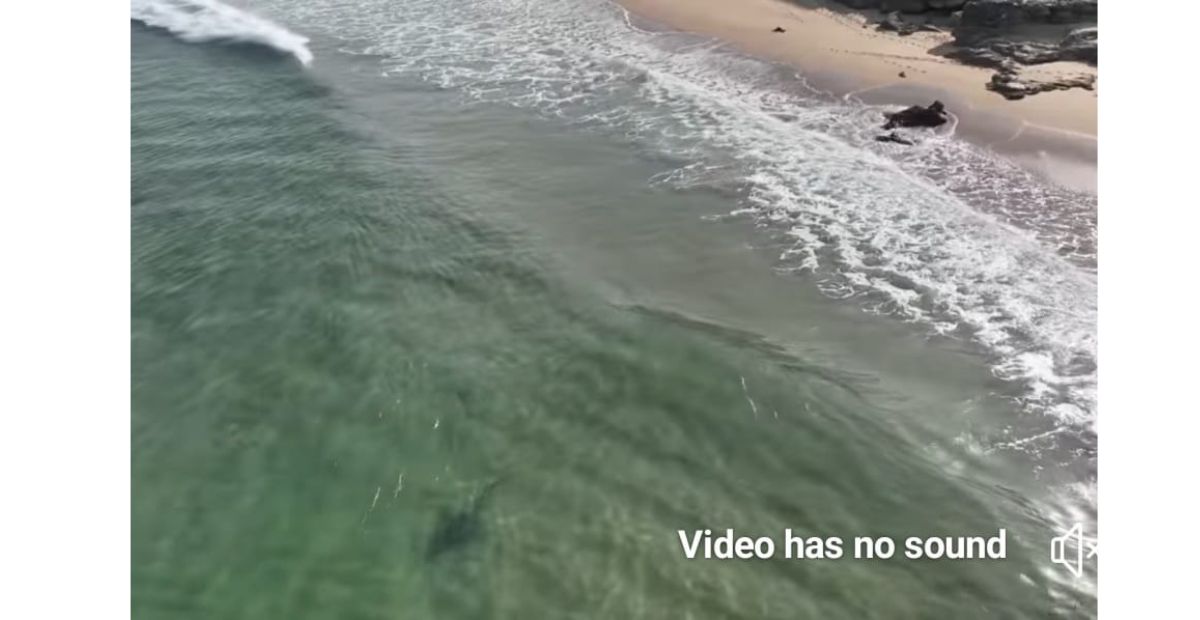

Drone Fanatics SA het hierdie hommeltuig-video op 27 Maart 2023 op sosiale media gedeel waar ‘n koperhaai baie naby aan Danabaai in die Mosselbaai-area naby die strand swem.
Christiaan Stopforth van Drone Fanatics SA sê hierdie haai moet met respek hanteer word, omdat dit steeds gevaarlik is.
Lees hier wat Christiaan Stopforth van hierdie haaispesie sê.
Now this is what you can call CLOSE TO THE BEACH
Luckily not a Great White but still a shark that can potentially cause harm and also needs to he treated with respect.
The copper shark (Carcharhinus brachyurus), bronze whaler, or narrowtooth shark, is a species of requiem shark, family Carcharhinidae, found mostly at temperate latitudes. It is distributed in a number of separate populations in the northeastern and southwestern Atlantic, off southern Africa, in the northwestern and eastern Pacific, and around Australia and New Zealand, with scattered reports from equatorial regions. This species can be found from brackish rivers and estuaries, to shallow bays and harbors, to offshore waters 100 m (330 ft) deep or more. Females are found apart from males for most of the year, and conduct seasonal migrations. A large species reaching 3.3 m (11 ft) long, the copper shark is difficult to distinguish from other large requiem sharks. It is characterized by its narrow, hook-shaped upper teeth, lack of a prominent ridge between the dorsal fins, and plain bronze coloration.
Feeding mainly on cephalopods, bony fishes, and other cartilaginous fishes, the copper shark is a fast-swimming predator that has been known to hunt in large groups, using their numbers to their advantage; however for most of the time they remain solitary. Off South Africa, this species associates closely with the annual sardine run, involving millions of southern African pilchard (Sardinops sagax). Like other requiem sharks, it is viviparous, with the developing embryos mainly nourished through a placental connection formed from the depleted yolk sac. Females bear litters of 7 to 24 pups every other year in coastal nursery areas, after a gestation period of 12 or perhaps as long as 21 months. It is extremely slow-growing, with males and females not reaching maturity until 13–19 and 19–20 years of age respectively.
This species is valued by commercial and recreational fisheries throughout its range, and utilized as food. The species population size is unknown, but the IUCN’s Red List assesses the species as vulnerable because it is very susceptible to population depletion due to its low growth and reproductive rates and because its numbers are believed to have declined in some areas.
Copper sharks only attack humans infrequently, but the species places tenth in the number of unprovoked attacks on people.
 Dana Bay, Mossel Bay, WC
Volg FiND iT se Facebookblad hier en klik hier om ons app af te laai. Klik hier vir vandag se nuutste nuus. As jy Afrikaanse Nuus op die Moya App wil lees, volg die skakel