
All you need to know about buying and upholstering sofas. real living’s Natalie Walton shares the lessons she learnt.
What’s your sofa style?
ONE OF THE biggest decorating decisions for your home revolves around the sofa. It’s a piece of furniture that gets plenty of use by family as well as guests, so it needs to be practical (easy to clean if you’ve got a young family) and functional (the right size for your space) as well as good looking (macro suede is out).
Once you’ve decided on the style, the rest of your decor scheme will fall easily into place. So before you get down to your final selection and consider the nitty-gritty details, you need to decide what kind of sofa is right for your place. Go to page 119 for some of our fave designs in each category. If you’re starting from scratch, we suggest you ask yourself the following questions:
What is the size of your living room? If you have a large, open-plan living space a love seat will get lost. Conversely, if you have a small room, then a clunky sectional sofa will overpower visually. Also, consider the shape of the room. Curved backs or arms can soften the lines of a small, boxy room, while a modular sofa (with moveable sections) can work wonders in an awkwardly shaped space.
How many people will use the sofa? If you have a large family, then two-seat sofas may not be the best option. Also, if you have pets or children – or both – sofas with covers that can be removed and washed can be a real lifesaver.
How important is comfort? It’s imperative that whoever is regularly going to use the sofa sits on it before buying – to test out what they’re going to spend considerable time upon. For instance, deep sofas are best suited to people with long legs. And if you enjoy lying down watching television, or reading the paper, then you’re better off choosing a sofa with low, comfy wide arms.
How much can you spend? Choose the right sofa now and you won’t have to buy another one for at least a decade. This is when falling for the latest trend in design or fabric can get you into trouble. A classic style (which sits in between traditional and modern) in a neutral fabric may be your best bet. How much you spend – it can be anywhere between $300 and $10,000 – will depend on how much you value quality. However, you can buy a hard-wearing sofa for $2000 to $3000.
Narrowing the selection
Once you have a sense of the style of sofa you want, here are some points to consider before making a final decision:
THE FRAME This should be heavy. Test it by lifting one corner of the sofa- and listen for creaking, too. For a sofa that will stand the test of time, look for a frame made of hardwood. And check for wood blocks in the base corners of the frame, which help reinforce its weight. Finally, a sitting test will check the angle of the sofa back and arm height.
THE SPRINGS You get what you pay for. The cheapest springs are usually web-sprung. In the mid-range you’ll find zigzag springs and at the top end you’ll get coil-sprung seats, which are the most comfortable.
THE FILLING This determines the firmness of the sofa. There are three types: foam, feather down or a combination. Cushions filled with foam are firm and spring back into shape, but if you like to sink into your sofa then consider feather-filled cushions – although they do need regular plumping. You can buy sofas with a mix of foam and feather down – usually they have a foam core and are surrounded by down.
THE UPHOLSTERY Leather is family-friendly as it can be easily wiped down. Dark colours hide dirt, but don’t blend into the rest of an interior as much as taupe or light neutrals. Removable covers can be a good option for families with children or pets.
THE SIZE Viewing sofas in a showroom can be deceptive so take measurements to determine whether the sofa you love will actually fit well into your room.
THE LEGS If you have a small space, consider low-back sofas or ones raised off the floor with visible legs. Low-lying sofas can help ground a large, open-plan space. A good trick to making a cheaper sofa look more expensive is to replace the legs with industrial-looking wheels, or have a loose-fitting slipcover made with a skirt to the floor.
TIP Knead sofa arms to feel if it’s well padded – you should not feel I wood under the filling.
How to reupholster a sofa
UPHOLSTERER If you have an old sofa that needs reviving, consider using an upholsterer. Get at least three quotes – you’ll be amazed by how much they vary – and always go on recommendation. If you don’t know anyone who has used an upholsterer, ask the company that you’re buying the fabric from if they can make any recommendations. Check out the upholsterer’s references, too – to be certain they’ll do a good job.
WHAT’S INVOLVED? The quickest and easiest way is to take a photo of the sofa you want reupholstered and provide dimensions so that the upholsterer can give you a quote. Depending on their workload, it can take several weeks for the job to be completed. Most upholsterers will include pick-up and delivery in the quote.
Five standard sofa shapes
ANTIQUE This French style suits shabby-chic homes. Upholster in contemporary fabric for a less formal look. Unpadded backs can be uncomfortable, so add cushions.
MID-CENTURY Clean lines suit frill-free homes. Cushions are supported on a frame, so you don’t end up sitting on a crack.
COUNTRY A more traditional style, featuring rolled arms. Slipcovers can be made for these sofas, giving a French-provincial look.
CLASSIC A style that eschews trends, it also works well in masculine interiors. Neutral palettes work best so it can take a backseat to other, stronger features in your room.
SECTIONAL Contemporary, modular and flexible (add to, subtract from or rearrange). Measure where it will live first.
How to decide on fabric
STYLE The fabric you choose should suit the style of your sofa and your lifestyle. Leather looks best on contemporary sofas (and is low maintenance), while vintage pieces can easily embrace patterned fabrics. If you want something lush, such as velvet, get one with a slight sheen so that it doesn’t “bruise” easily. However, too much sheen can look like a cheap suit, and be the wrong look if the rest of your space is informal. If linen is your preference, consider slipcovers as they can be washed regularly. Getting a spare set is a good idea so you can rotate them to prolong the life of your sofa.
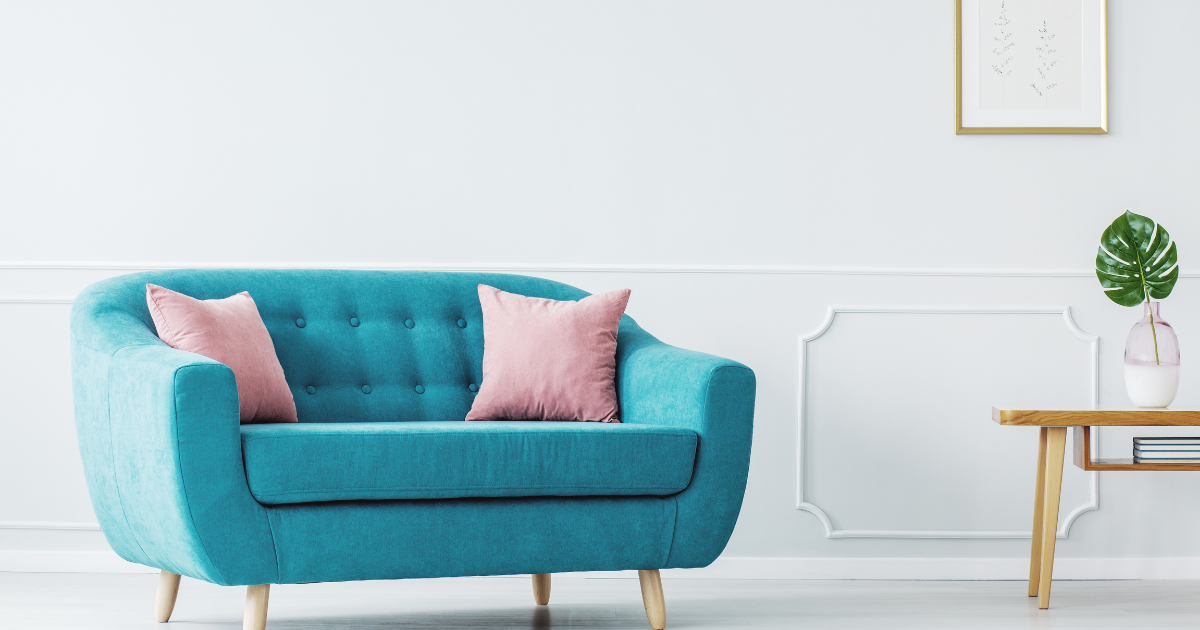
COLOUR Neutral is the safest, easiest option, and is more likely to stand the test of time, outlasting more fashionable choices. But it can border on boring if you’re a fan of brighter colours. Just keep in mind that if you do decide on a strong colour, such as teal blue, you may tire of it sooner. On the other hand, it may give you a thrill every time you see it. The deciding factor on whether you go safe or strong may come down to how you want to decorate the rest of your interior. If you choose a neutral sofa colour we suggest you introduce stronger decorating elements in your accessories such as lights, rugs or vases. However, if you go for a stronger colour then you will need to pare it down. In the case of teal blue, you would be best teaming it with neutral colours, such as French grey linen cushions and white rugs, or a natural sisal rug.
PATTERN If you go for a pattern such as stripes, they are usually upholstered vertically. (Although if you have one long cushion – such as the one on the sofa shown opposite – you may have to upholster horizontally otherwise there will be a seam down the centre of the cushion.) If the pattern is floral, you will need to centre the fabric on the sofa and buy extra material to match the “repeat” (the point at which the pattern starts again). If the pattern has a large repeat you’ll have to buy much more fabric to match the material (the same principle applies to wallpaper), which can be a costly exercise.
TIP With slipcovers for your sofa: prewash the fabric so that it will shrink before it’s cut to size.
ALSO READ: Take a load off and delegate Superwoman