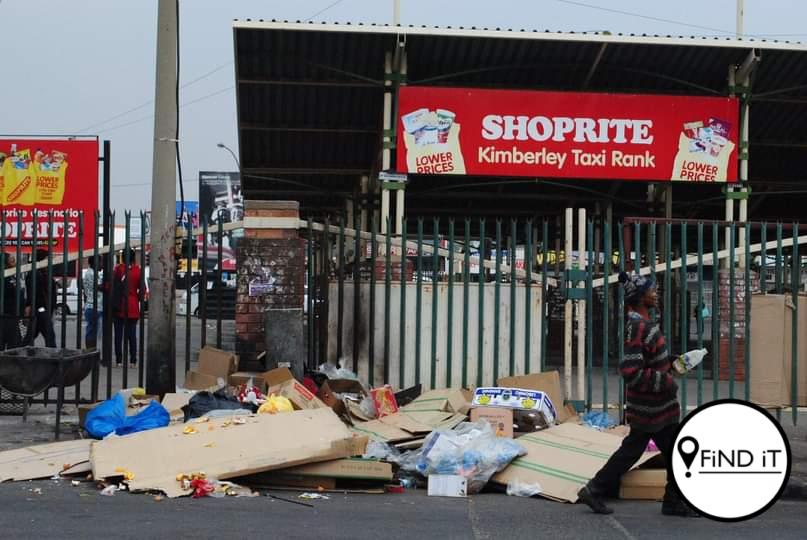

Tumelo Mosikare, a citizen of Kimberley in the Northern Cape, debates whether the state of the streets of Kimberley, are, in fact, the municipality’s concern or the residents themselves.
“Before you bite my head off, note that I’ve included myself… what if the city looks the way it does because we have lost our Kimberliness as people who were either born here, came here and have stayed on?
It has become okay to throw things out the window when driving and kids have caught on. We (some of us) send the kid to take the dirt to the sloot or corner where it stops being our problem temporarily until the litter breeds mice, mosquitoes, flies or builds up and blocks the flowing water to cause floods or water stagnation on roads which eventually create potholes.
Yes, there are lesser bins in the CBD than there were before. There are few bins at the malls but we tend to respect those spaces more because everybody is watching and we would not want to spoil our image in public.
It used to be about pride and self love that the city and our neighbourhoods remained clean. Now some of us throw things on the ground because it’s job creation or because it’s easier to pass on ones challenge/problem to everybody or the street where it bothers no one… supposedly.
We really need an introspection as individuals, businesses and families.
During the tougher restrictions, level 5… (unfortunately I did not take pictures) the town was CLEAN. Hotspots where litter used to pile up or be scattered were clean. It was clear that it is us who are dirtying our streets, and city.
In no way is it not the duty of the Sol Plaatje Municipality to clean up, to maintain the roads, to maintain the storm water channels, the sewerage drains, tend to the leaks… these are squarely their responsibility.
My question is: what is ours? Many will say: ‘I pay so, do not ask me to pick up litter.’ True, we pay… but our role does not end there.
It is clear, and has been for a while, that the municipality is not fully interested in running an efficient service delivery programme, it is becoming more clear that in fact, it is incapable.
Due to all the reasons (valid some) and excuses we have become accustomed to.
Our role needs to resemble that of our parents, our grandparents. The ones that before going to work or pension ensured it was clean in front of the yard. That would scold a kid regardless whose it was if they did not put the empty packet of chips inside the bin or pocket to throw it away when they got to a bin.
Complaining about the filth will not miraculously make it disappear. It has the tendency of returning because we have become those people. Die ‘morsige mense van die corner’/’morsige mense van next door’. Our city’s state is a reflection of our current habits.
For things to change we need desperately to stop looking outside for the problem or the solution – there is no help coming!
We are the cause and hopefully through truthful reflection, will realize that we can be the solution as well.
When you get to town, count how many bins you see.
The ones you pass, peep inside to see just how little space they have in them. If there have not been any bins provided for the past five years for a population that has grown, you can imagine the amount of work we have been giving the old ladies to sweep the streets during the day, in the afternoon and early mornings, walking street by street.
We have our opinion about EPWP workers, however there are many who are passionate about their work.
We need to help better the city by playing our part, unless if we honestly believe it can be done by the limping municipality alone.
When your kids are older, they will either be part of the problem or be joyful to call Kimberley home.. because of the role you played now and the habits you teach them now.
ARE YOU PART OF THE PROBLEM OR THE SOLUTION?”