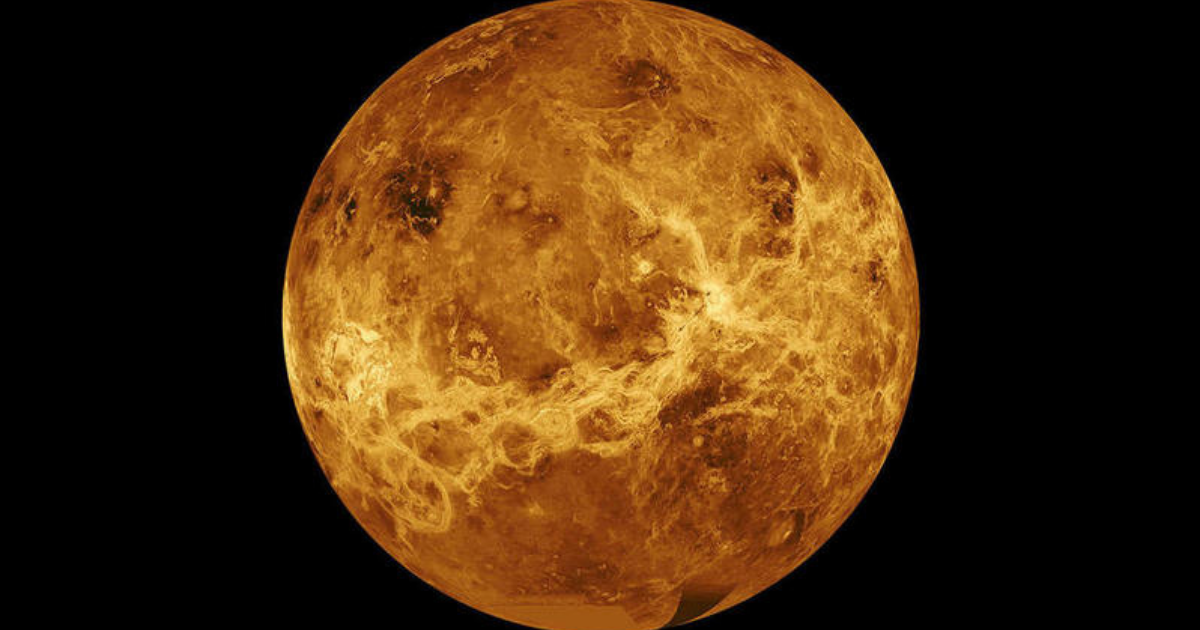

Part of the NASA Discovery Program, the missions aim to understand how Venus became an inferno-like world when it has so many other characteristics similar to ours – and may have been the first habitable world in the solar system, complete with an ocean and Earth-like climate.
These investigations are the final selections from four mission concepts NASA picked in February 2020 as part of the agency’s Discovery 2019 competition. Following a competitive, peer-review process, the two missions were chosen based on their potential scientific value and the feasibility of their development plans. The project teams will now work to finalize their requirements, designs, and development plans.
NASA is awarding approximately $500 million per mission for development. Each mission to Venus is expected to launch in the 2028-2030 timeframe.
The selected missions are:
DAVINCI+ (Deep Atmosphere Venus Investigation of Noble gases, Chemistry, and Imaging)
DAVINCI+ will measure the composition of Venus’ atmosphere to understand how it formed and evolved, as well as determine whether the planet ever had an ocean. The mission consists of a descent sphere that will plunge through the planet’s thick atmosphere, making precise measurements of noble gases and other elements to understand why Venus’ atmosphere is a runaway hothouse compared the Earth’s.
In addition, DAVINCI+ will return the first high resolution pictures of the unique geological features on Venus known as “tesserae,” which may be comparable to Earth’s continents, suggesting that Venus has plate tectonics. This would be the first U.S.-led mission to Venus’ atmosphere since 1978, and the results from DAVINCI+ could reshape our understanding of terrestrial planet formation in our solar system and beyond. James Garvin of Goddard Space Flight Center in Greenbelt, Maryland, is the principal investigator. Goddard provides project management.
VERITAS (Venus Emissivity, Radio Science, InSAR, Topography, and Spectroscopy)
VERITAS will map Venus’ surface to determine the planet’s geologic history and understand why it developed so differently than Earth. Orbiting Venus with a synthetic aperture radar, VERITAS will chart surface elevations over nearly the entire planet to create 3D reconstructions of topography and confirm whether processes such as plate tectonics and volcanism are still active on Venus.
VERITAS also will map infrared emissions from Venus’ surface to map its rock type, which is largely unknown, and determine whether active volcanoes are releasing water vapor into the atmosphere. Suzanne Smrekar of NASA’s Jet Propulsion Laboratory in Southern California, is the principal investigator. JPL provides project management. The German Aerospace Center will provide the infrared mapper with the Italian Space Agency and France’s Centre National d’Etudes Spatiales contributing to the radar and other parts of the mission.
ALSO READ: 8 ways to improve your sleeping problems and habits